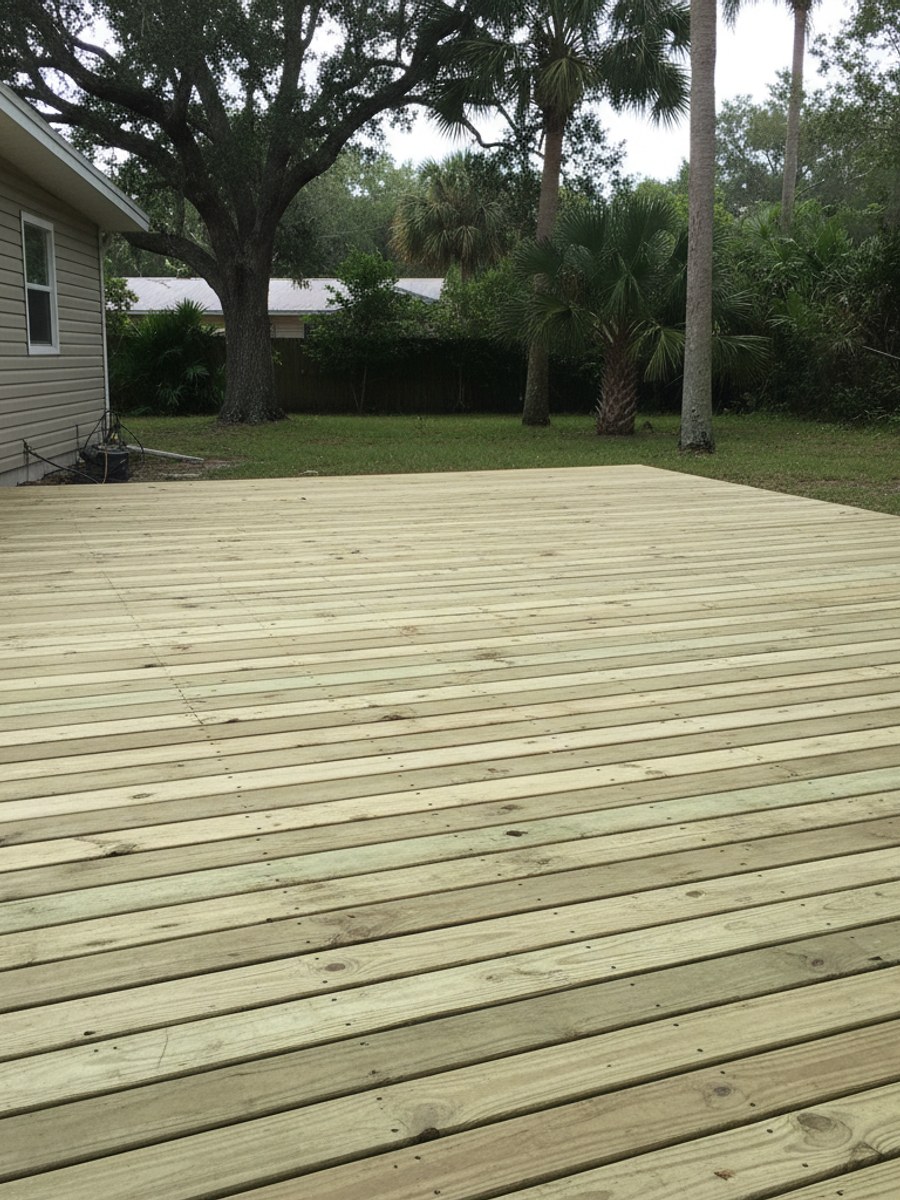
Englewood sits between Lemon Bay and a lot of canal-front lots, and that changes what a deck actually has to survive here. Picking a builder isn't just about who quotes the lowest number. It's about who understands sandy soil, salt air, and a hurricane season that runs June through November. Get it wrong and you find out three years in, when the ledger board is soft and the railing posts wobble.
Check the license before you look at anything else
Florida requires a state contractor license for deck construction, not just a business card and a truck with a logo on it. Depending on the scope, that's a certified or registered building contractor license, and you can look it up yourself on the Florida DBPR website in about two minutes. Ask for the license number up front. Ask for a certificate of insurance too, both general liability and workers' comp. If a crew shows up without workers' comp and someone falls off a ladder on your property, that bill can land on you.
A lot of guys doing decks in this area work under someone else's license or no license at all. They're usually cheaper. They're also the ones who disappear halfway through the job or leave you holding a deck that never passed inspection because there was no permit to inspect in the first place.
What the ground and the weather here actually do to a deck
The soil around Englewood is mostly sand, which drains fast but doesn't hold a footing the way clay does further inland. Footings need to go deep enough and wide enough to bear weight in loose sand, not just meet some minimum on paper. Undersized footings are one of the more common reasons an older deck starts to lean.
Wind load matters more here than in most of the country. Charlotte County falls in a high-velocity zone under the Florida Building Code, and an attached deck has to be engineered to resist uplift, not just gravity. That means hurricane clips at the joists, a ledger bolted through with lag screws or through-bolts on a real pattern (not just a handful driven in wherever), and flashing behind that ledger so water doesn't get behind it during the next tropical storm and start rotting the house band board from the inside.
Salt air off the bay eats regular fasteners. Coated deck screws that would be fine in Ohio will bleed rust streaks down composite boards here within a season. Stainless steel fasteners cost more and are worth it within a mile or two of the water. Pressure-treated pine also moves more in this humidity than people expect, cupping and checking as it dries out between our afternoon thunderstorms. Composite decking handles the moisture better but gets legitimately hot to walk on barefoot in July, something worth knowing before you commit to a dark color on a west-facing deck.
Permits aren't a formality here
Any deck attached to the house, and most freestanding ones over a certain height, needs a permit through Charlotte County or the City of Englewood building department depending on where the lot sits. A decent builder pulls that permit themselves and doesn't ask you to do it, and doesn't offer to "skip it" to save time.
Expect at least two inspections: one on the footings or piers before any concrete gets poured or covered, and a framing inspection before the decking boards go down and hide the joists. A final inspection closes it out. On canal lots, which are common in this area, setbacks get checked against your survey, and if you're near mean high water there can be additional review. If your neighborhood has an HOA, and quite a few of the waterfront and newer developments do, factor in their approval process before the permit even goes in.
Red flags worth walking away from
- No written contract, or one that's a single paragraph with a price and nothing else.
- Asking for full payment before any work starts.
- Vague or dodgy answers about the permit, especially "we usually just build it and deal with it later."
- A quote that's dramatically lower than two or three others for the same square footage and material.
- No mention of flood zone or elevation on a waterfront lot, which affects how the structure has to be built.
- A builder who can't tell you what hanger brand or fastener spec they use, or shrugs when you ask.
None of these alone means someone's a bad builder. All of them together usually does.
Questions worth asking before you sign anything
Ask what the joist spacing will be (16 inches on center is standard for most decking, tighter for some composites) and whether they're using hangers rated for the load and the coastal environment. Ask how deep the footings go and whether that's based on an engineer's spec or just habit. Ask who pulls the permit and whose name is on it. Ask what the warranty covers and for how long, and get it in writing, not just said out loud on the porch.
A deck built right here should hold up through a decade or more of salt air, sun, and storm season without the railings loosening or the boards cupping. That comes down to footing depth, fastener choice, and someone who actually thinks about wind uplift before the first post goes in the ground. That's the kind of build we do at Omega Deck Co, and it's worth asking any builder you're considering the same questions before you decide who gets the job.